DataTable proved one fix and exposed another missing public type
/usersCaptured at a 375px viewport. Long pages scroll inside the frame.
The screenshots stay in Japanese. Every round is a real screen for a real Japanese industry, so an English re-render would no longer be the screen the agent actually produced.
Write-up
DataTable proved one fix and exposed another missing public type
Build log series: I hand a real screen to an AI that has never seen Gunjo (
@gunjo/ui) and let it build. After #1 through #5, login, this round covered an admin data table.
The conditions stayed the same: the package exactly as shipped, including the fixes from issues #52 and #53, plus the docs, with no source access or provider hint. The assignment was a user list of about 16 rows, with name, role, status, join date, and monthly recurring revenue. It needed text search, a Select status filter, column sorting, pagination, and status badges.
Result: 4/5. Issue #52 held again
npm run build passed, the page rendered statically, and the console stayed clear. Search, status filtering, column sorting, and pagination all worked.
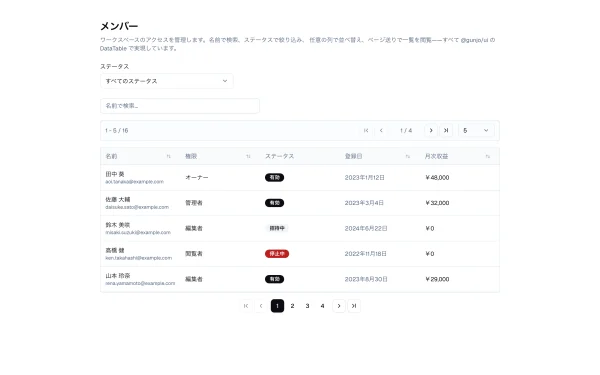
The cold agent selected DataTable, which is based on TanStack Table, and found sorting, pagination, and text filtering built in. It also confirmed the earlier fix:
No provider required.
DataTableuses Radix Tooltip for sortable headers and pagination, but Gunjo'sTooltipprovides what it needs internally. There is no<TooltipProvider>wrapper and no server-side rendering crash.
The defect found in #3 and fixed in issue #52 did not return in a tooltip-heavy DataTable. The loop remained closed.
The rough edge: another missing export revealed a pattern
The omission did not stop the build, but it blocked consumers who wanted to use the public type.
import { type ColumnDef } from "@gunjo/ui" // Not exported
The columns prop on DataTable required ColumnDef, but the shared @gunjo/ui entry point did not export that type. Consumers had to import it directly from @tanstack/react-table. That package was only a transitive dependency, absent from their own package.json, so strict installation setups could break. I logged issue #56, and the export landed in PR#59.
This was the same class of problem as ChartDataPoint in #4, tracked in issue #53. A public component required a type through its public props, but the main @gunjo/ui entry point did not export it. That made it a pattern, not a lone bug. Issue #56 therefore covered an audit of every public prop type, not only the ColumnDef export. As with the tooltip defect from #3, one example should trigger a fix for the whole class.
Other rough edges:
- The docs' code examples still did not appear in fetched content, the known issue issue #50. Bundled TypeScript types let consumers reconstruct the composition.
DataTablefilters text in a single column. The agent handled the statusSelectoutside it withuseMemo, a clean composition around an intentional constraint.- The inner
<table>usesmin-w-[720px], so extremely narrow screens scroll horizontally instead of reflowing. That was minor here.
What I took away
Have the AI use it | Find a rough edge | Fix the whole class, not one instance | Run it again
Round six showed both sides of the loop. The defect fixed in issue #52 stayed gone in another complex component. Meanwhile, issue #56 matched issue #53 and turned a single missing export into an audit. The series was revealing a more effective way to raise quality: remove whole classes of defects, such as missing types and missing providers, instead of patching one component at a time.
Next up: build log #7
- A Command-K palette using
CommandandDialog, a search interface for power users.
The run
- gunjo.jp / npm
@gunjo/ui/ GitHub - Earlier rounds: #1 / #2 / #3 / #4 / #5
- Overview: Gunjo (
@gunjo/ui) / Why it exists: Design systems in the age of AI - GunjoUI by UIXHERO
Gunjo was still in early alpha at the time; issues are welcome.
This series is co-created with AI (Claude and Codex). A human designs the experiments, makes the calls, and fact-checks before publishing; the AI does the hands-on work and drafting.
Components from @gunjo/ui
The components this screen's source imports directly.
The code the agent actually wrote
Click a file to expand its source.