CommandPalette worked from one prop, then flagged its own accessibility
/commandCaptured at a 375px viewport. Long pages scroll inside the frame.
The screenshots stay in Japanese. Every round is a real screen for a real Japanese industry, so an English re-render would no longer be the screen the agent actually produced.
Write-up
CommandPalette worked from one prop, then flagged its own accessibility
Build log series: I hand a real screen to an AI that has never seen Gunjo (
@gunjo/ui) and let it build. After #1 through #6, a data table, this round covered the familiar power-user pattern: a Command-K palette.
The conditions stayed the same: the package exactly as shipped and the docs, with no source access or hints about wrappers such as TooltipProvider. The assignment covered a palette opened with Command-K or Ctrl-K, input filtering, grouped commands (Navigation, Actions, and Settings), icons, shortcut labels, keyboard navigation with the arrow keys and Enter, dismissal after selection, and a confirmation toast.
Result: 4.5/5. Tied for the series high
npm run build passed, and the page rendered statically. The console stayed clear on load. Opening with Command-K, filtering by typing, moving through results with the arrow keys, running one with Enter, and closing with Escape all worked.
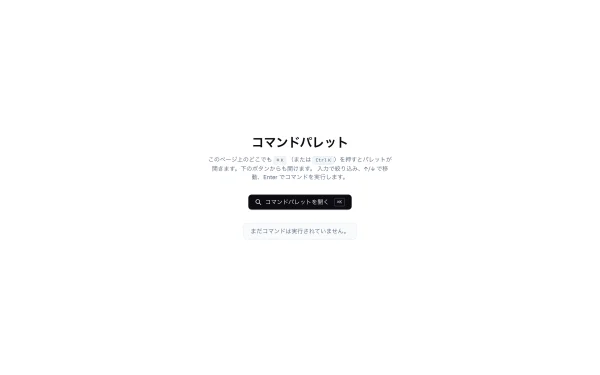
The cold agent found more than the low-level Command component. It also discovered the high-level CommandPalette, which works from data alone.
A single typed
groupsprop provides the search field, grouped commands, icons, shortcut labels, keyboard navigation, and closing behavior for Escape.
The earlier provider fix held too:
No provider required for the palette. It handles the popup and focus management itself. It opened cleanly during server-side rendering without a
<TooltipProvider>wrapper.
The agent only had to pass an array of { id, label, icon, shortcut, action }. That is a strong API.
The rough edge: an accessibility library warned about its own dialog
The warning appeared during development but did not stop the build.
Warning: Missing `Description` or `aria-describedby={undefined}` for {DialogContent}.
CommandDialog included a visually hidden Title for screen readers, but it omitted the corresponding Description and aria-describedby in Command.tsx:59. The warning appeared only in development, yet it was hard to excuse. A library that promises built-in accessibility was emitting its own accessibility warning. Screen readers had no dialog description to announce. I logged issue #57, and the accessibility fix landed in PR#59.
That finding was uncomfortable, but it is exactly what the cold test is for. A claim such as built-in accessibility must survive an actual run. The test shows where reality falls short. No embellishment and no hiding the warning.
Other findings:
- The docs' code examples still did not appear in machine-fetched content, the known issue #50.
Command,CommandPalette, andTablecontain duplicate classes such asw-[Npx] w-full. The later class wins, so they are harmless, but the pattern needs cleanup across components.
What I took away
Have the AI use it | Find where a claim fails | Fix it | Run it again
Round seven found a gap between the promise of built-in accessibility and the implementation. CommandPalette was excellent and earned 4.5/5, while the same dialog retained an accessibility warning. One screen showed both what worked and where the claim was not yet true. Both belong in the record.
Next up: build log #8, then a pause
- Empty, loading, and toast states using
EmptyState,Skeleton, andToast. Everyone needs these states, but few people want to build them. This will complete the first pass through the main categories.
The run
- gunjo.jp / npm
@gunjo/ui/ GitHub - Earlier rounds: #1 / #2 / #3 / #4 / #5 / #6
- Overview: Gunjo (
@gunjo/ui) / Why it exists: Design systems in the age of AI - GunjoUI by UIXHERO
Gunjo was still in early alpha at the time; issues are welcome.
This series is co-created with AI (Claude and Codex). A human designs the experiments, makes the calls, and fact-checks before publishing; the AI does the hands-on work and drafting.
Components from @gunjo/ui
The components this screen's source imports directly.
The code the agent actually wrote
Click a file to expand its source.