A modal announcement exposed a provider bug and machine-thin docs
/announceCaptured at a 375px viewport. Long pages scroll inside the frame.
The screenshots stay in Japanese. Every round is a real screen for a real Japanese industry, so an English re-render would no longer be the screen the agent actually produced.
Write-up
A modal announcement exposed a provider bug and machine-thin docs
Build log series: I hand a real screen to an AI that has never seen Gunjo (
@gunjo/ui) and let it build. Each article doubles as a guide to building it with Gunjo. After round one, the settings screen, this round covered a modal announcement banner.
The conditions matched the previous round. I gave one agent with no knowledge of Gunjo only the public npm package @gunjo/ui (alpha.2) and the gunjo.jp docs. It could not see the source repository. It had to work from a blank Next.js app (React 19 and Tailwind v4) and get through npm run build on its own.
The assignment
This is the announcement pattern almost every product needs.
- A dismissible banner at the top, with "v2 is live," a call to action, and a close button
- An announcement modal opened from the banner, with a title, body, primary and secondary buttons, and automatic opening on the first visit
- A confirmation toast after dismissal or acknowledgment: "You're all caught up"
This round crossed different categories from the first: Feedback (Banner and Toast) and Overlay (Modal). Each new round sends a cold agent through another part of the component catalog.
Result: 4/5. It worked
npm run build passed, /announce rendered as a static page, and I confirmed zero console errors on a real device.
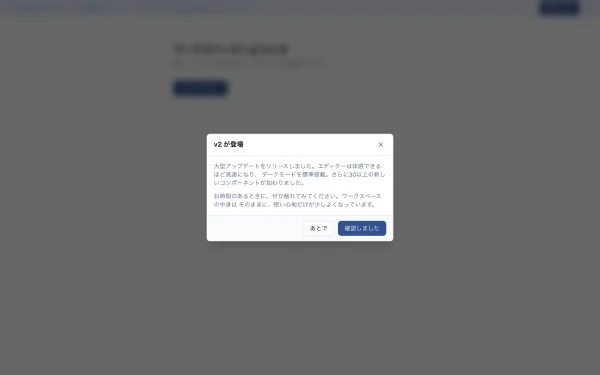
Once again, the most useful feature was having every typed component available from one place, @gunjo/ui. After reading src/index.ts, the agent found Banner, Modal, Toast, ToastProvider, and useToast. The import resolved with no path adjustments: import { Banner, Modal, ToastProvider, useToast } from "@gunjo/ui". It also read the prop contracts directly from the bundled .tsx source: action and onDismiss on Banner, isOpen and footer on Modal, and showToast(msg, type) returned by useToast(). It never needed a className override.
Two rough edges, one of them painful
1. Banner crashed SSR on its own: a library bug
The first build failed.
Error: `Tooltip` must be used within `TooltipProvider`
The cause was an inconsistency. The close button inside Banner used Tooltip, but Banner did not provide the TooltipProvider that tooltip required. Toast, in the same Feedback category, wrapped its tooltip in a provider. A straightforward <Banner onDismiss> therefore crashed during server-side rendering (SSR). The agent worked around it by wrapping the page in <TooltipProvider>.
// Final version written by the agent (excerpt)
export default function AnnouncePage() {
  // Banner's dismiss action uses an internal Tooltip without its own provider,
  // so a standalone Banner needs TooltipProvider above it. Toast does not.
  return (
    <TooltipProvider>
      <ToastProvider>
        <Announcement />
      </ToastProvider>
    </TooltipProvider>
  )
}
This was not user error. It was a trap in the library. I checked the source and logged issue #49. The fix was to make Banner provide its own TooltipProvider, just as Toast did, and align design, implementation, and documentation. It landed in PR#51, with design:verify passing. It was the same correction path as issue #47.
2. My docs were thin from the agent's perspective
This finding stung more. The agent reported that the docs' code examples were client-side widgets that did not appear in WebFetch or Markdown extraction. Some prop descriptions existed only in Japanese. The bundled TypeScript types, not the docs, became its most reliable API reference.
That cuts straight into the claim that Gunjo is usable by AI. The docs site itself was difficult for a machine to read. The typed entry point and bundled declarations carried the run to 4/5, but the weakness reached the foundation of the idea. The agent also tried /docs/feedback/banner and got a 404 because the real route is the flat /docs/components/banner. The install guide never mentioned ToastProvider. These are small details until an agent with no prior knowledge gets stuck on them.
What I took away
Have the AI use it | Find the rough edges | Fix every source consistently (SSOT) | Run it again
Round one found fixed widths. Round two found the Banner provider bug and asked whether the docs were machine-readable at all. New angles reveal rough edges that the happy path never shows. "AI can use it" is not a declaration. I can prove it only by repeatedly giving the library to an agent with no prior knowledge and removing what blocks it. No embellishment and no hiding the misses.
Next up: build log #3
- A carousel using
CarouselandCard, a frequent centerpiece on landing pages and in media lists.
The run
- gunjo.jp: docs, showcase, and patterns
- npm:
@gunjo/ui / GitHub - Previous round: I gave an AI a settings screen to build, build log #1
- Overview: Gunjo (
@gunjo/ui): one design system aligned around a single source of truth - GunjoUI by UIXHERO
Gunjo was still in early alpha at the time; issues are welcome.
This series is co-created with AI (Claude and Codex). A human designs the experiments, makes the calls, and fact-checks before publishing; the AI does the hands-on work and drafting.
Components from @gunjo/ui
The components this screen's source imports directly.
The code the agent actually wrote
Click a file to expand its source.