Ugly data could not break the charts, but one missing type broke the build
/dashboardCaptured at a 375px viewport. Long pages scroll inside the frame.
The screenshots stay in Japanese. Every round is a real screen for a real Japanese industry, so an English re-render would no longer be the screen the agent actually produced.
Write-up
Ugly data could not break the charts, but one missing type broke the build
Build log series: I hand a real screen to an AI that has never seen Gunjo (
@gunjo/ui) and let it build. After #1, settings, #2, a modal announcement, and #3, a carousel, this round reached a core differentiator: dashboard charts.
Gunjo's charts are built from HTML and CSS layout components, not SVG. The goal is to survive arbitrary data. They need to hold up under messy real-world inputs, not only polished sample data: wildly different scales, outliers, zeros, and tiny values.
I had the cold agent stress-test that claim. The conditions stayed the same: only the public npm alpha.2 package and the gunjo.jp docs, with no source access. The assignment was an analytics dashboard at /dashboard, with KPI cards, several charts, and a data table.
Result: 4/5. The dashboard worked, and the charts held up
npm run build passed, the page rendered statically, and the console stayed clear.
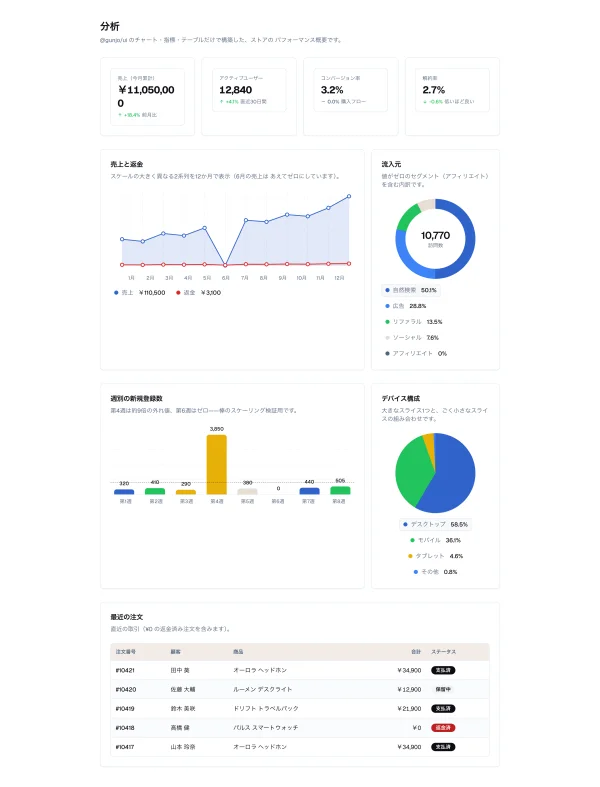
The agent deliberately supplied hostile data. As the screenshot shows, every case rendered correctly:
- Two series on different scales, revenue in the tens of thousands and refunds in the thousands, shared one line chart. Refunds hugged the baseline without breaking the layout.
- A zero in the middle of a series, June revenue at $0, dropped sharply to the baseline and recovered.
- A ninefold outlier and a zero bar, W4 at 3,850 and W6 at 0, let the outlier set the maximum while the zero bar stayed empty and the average line remained correct.
- A zero-value donut segment, Affiliate at 0%, displayed 0% without
NaNor a brokenconic-gradient. - A tiny pie slice, Other at 0.8%, stayed visible even at that width.
The claim that layout components keep charts stable under arbitrary data survived the stress test. Rounds one through three found rough edges. Round four proved one of the library's selling points.
The typed entry point helped again. The agent immediately found LineChart, BarChart, DonutChart, PieChart, Statistic, and Table. A common data contract, ChartDataPoint = { label?, value, color? }, makes every chart easier to understand, and formatting values requires only an Intl.NumberFormat passed to formatValue.
The rough edge: one missing type undermined typed discovery
One real bug still stopped the build.
import { type ChartDataPoint } from "@gunjo/ui" // Not exported
Every chart expected ChartDataPoint through its public props, but the type was not exported from the shared @gunjo/ui entry point. It stopped inside chart-utils.ts. Consumers who wanted to type chart data could not refer to its contract by name. The agent copied the same type locally as a workaround, but the omission undercut Gunjo's promise that following the types reveals how a component works. I logged it in issue #53, and the export landed in PR#54.
Other rough edges:
- The docs' code examples still did not appear in fetched content. Issue issue #50 from round two was not deployed, so the agent reconstructed the call pattern from types.
- The docs do not explain that
LineCharttakes its x-axis labels from the longest series. - The
Tablewrapper carries bothw-[400px]andw-full. The duplicate classes are harmless but look like residue.
What I took away
Have the AI use it | Find the rough edges | Fix every source consistently (SSOT) | Run it again
Round four established two things. First, the charts really do survive arbitrary data. The claim held. Second, the missing type export blocked consumers who wanted to work from types. I can show the strength without inflating it and add the flaw to the issue list without hiding it.
Next up: build log #5
- Login and sign-up using
Form,Input,Button, andTabs, an authentication pattern with high search demand.
The run
- gunjo.jp / npm
@gunjo/ui/ GitHub - Earlier rounds: #1, settings / #2, modal announcement / #3, carousel
- Overview: Gunjo (
@gunjo/ui) / Why it exists: Design systems in the age of AI - GunjoUI by UIXHERO
Gunjo was still in early alpha at the time; issues are welcome.
This series is co-created with AI (Claude and Codex). A human designs the experiments, makes the calls, and fact-checks before publishing; the AI does the hands-on work and drafting.
Components from @gunjo/ui
The components this screen's source imports directly.
The code the agent actually wrote
Click a file to expand its source.